
GREEN CABINET SOURCE / VERIFIED PATH
Composite-Wood Cabinet Labels: What TSCA Title VI Tells Buyers
A cabinet door can look like solid wood while its centre is MDF. A cabinet box may have plywood sides and particleboard shelves. The surface alone will…
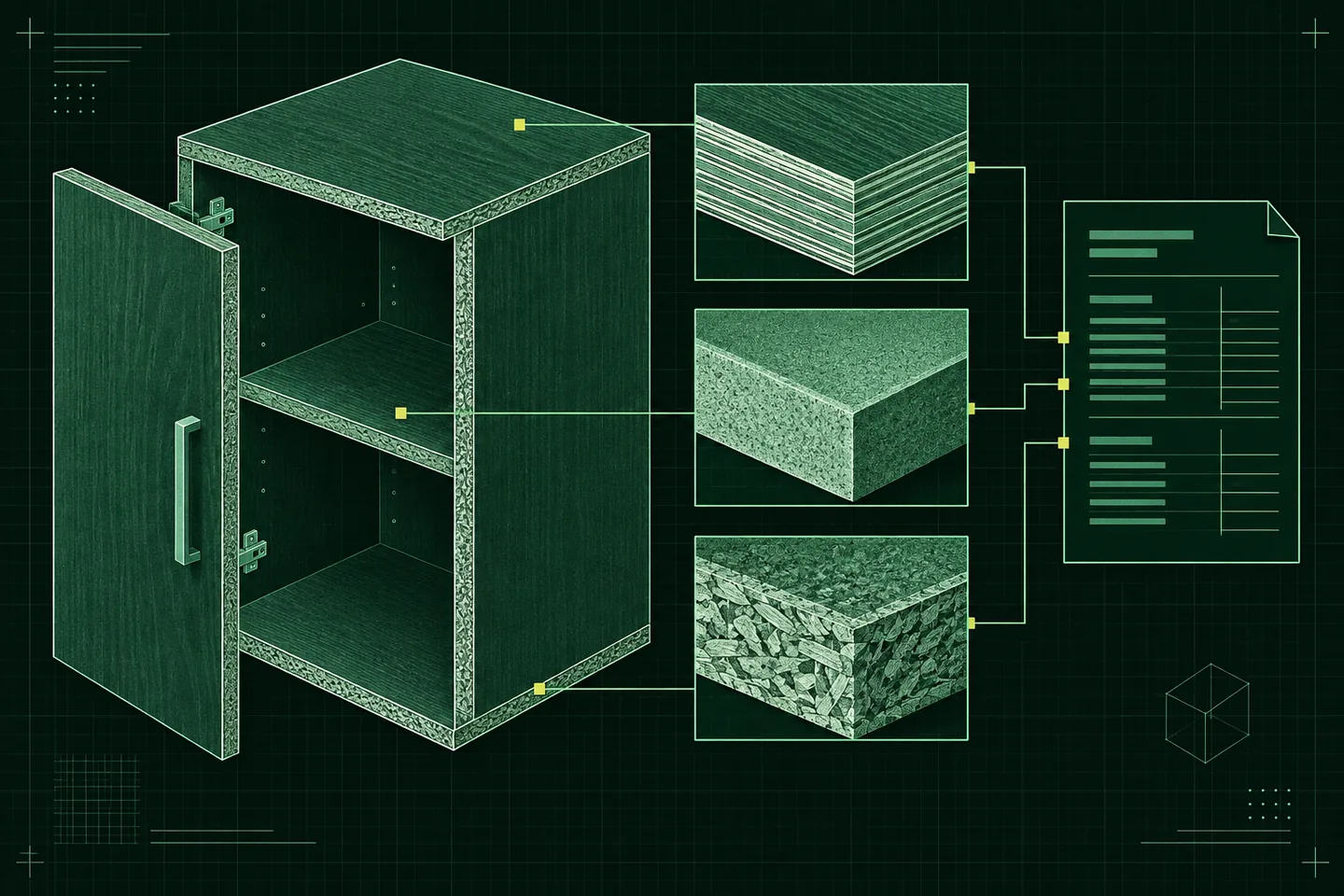
A cabinet door can look like solid wood while its centre is MDF. A cabinet box may have plywood sides and particleboard shelves. The surface alone will not tell you which panels are inside or what an emissions label covers. For a cabinet sold in the United States, TSCA Title VI addresses formaldehyde emissions from specified composite-wood panels. It does not measure the air in your home or assess every material in the finished cabinet.
Identify the panels in each component
Ask what forms the box, back, shelves, drawer parts and doors. A painted or veneered face can conceal a different core; components in one cabinet line need not use the same panel. If a seller says “solid wood”, ask whether that describes the entire door or just its frame. If the description says “plywood”, check whether it includes shelves and drawer parts.
TSCA Title VI regulates three composite-wood categories: hardwood plywood with a covered veneer or composite core, medium-density fibreboard (MDF, including thin MDF), and particleboard. MDF uses wood fibres and resin; particleboard uses wood particles and resin. The rule distinguishes panel types by construction, so “engineered wood” is too broad to establish which standard applies. The EPA’s consumer FAQ identifies the covered categories and their use in cabinets.
These names do not rank the quality of complete cabinets. A panel’s compliance concerns one emissions requirement; fit, durability and finish are separate buying questions. Get a component list for the actual model and configuration, particularly if you are comparing a display cabinet with one that will be supplied later. Check any proposed substitution against that list.
Descriptions of door fronts deserve particular care. A veneer names the visible wood layer, while the substrate underneath may be a regulated composite panel. A painted door may have a solid-wood frame and an MDF centre, or a different construction altogether. Ask the seller to name the core rather than infer it from the finish. Record the answer for each component so that a later change of colour or door style does not silently change your material choice.
Understand what compliance means
TSCA Title VI sets formaldehyde emission limits for regulated panels. Panel producers follow testing and certification requirements involving an EPA-recognised third-party certifier. A fabricator that uses those panels in a finished cabinet has different obligations: the finished good does not need its own formaldehyde emissions test or third-party certification, but its regulated panels must comply and the finished good generally needs the required label. EPA distinguishes panel testing from finished-good requirements in its stakeholder FAQ.
If someone calls a cabinet “certified”, ask what was certified. They may mean its panels, a separate voluntary programme, or another feature. A TSCA Title VI statement on a cabinet is a compliance statement about the regulated material in its supply chain, not a test result for that assembled cabinet or a measurement of conditions in your kitchen.
Compliance does not mean zero formaldehyde emissions. The rule permits emissions within limits that differ by panel type. “No-added formaldehyde” describes a resin category relevant to particular provisions of the rule; it is not a promise that a cabinet emits nothing. For a stronger claim, ask which substance and product were tested, when, and what the result shows. Do not treat a broad “low emissions” description as a substitute for the specific TSCA Title VI information.
Read the finished-good label
For a finished good containing regulated composite wood, the label can be on the item or its box or bundle. It identifies the fabricator, gives the production month and year, and states that the finished good is TSCA Title VI compliant. If an individual item is unlabelled, an importer, distributor or retailer must retain the label, connect it to the products it covers and make its information available to potential customers on request. A limited exception applies to finished goods with a small amount of regulated composite wood; an absent sticker alone does not establish a breach. EPA sets out the finished-good labeling requirements here.
A raw panel label is different. It names the panel producer and lot, supplies the EPA-recognised third-party certifier number, and states TSCA Title VI compliance. Panels or bundles may be labelled before fabrication, so a buyer need not see a panel label on each cut cabinet part. The useful question is how the seller connects the panels used in your cabinet model to compliant supplies. A sample label from another product or an unrelated showroom display cannot make that connection.
Request the finished-good label or its retained information in writing, naming the cabinet model or product description. Ask for a component list that identifies the substrates in the box and doors, and for an explanation of how regulated panels in those components are traced to compliant material. If a seller offers a panel test report, check its panel type, producer and lot against the product information. EPA requires panel producers to provide quarterly testing records to their direct purchasers; that does not give every retail customer an automatic right to a report. A seller may instead be able to provide the applicable label and traceable product details.
Compare the name on the label with the fabricator named in the seller’s paperwork, and make sure the label information covers the item you will receive. A generic statement about every product in a catalogue may leave that connection unclear. If cabinets arrive in several boxes, keep the relevant labels until you have checked that the delivered parts match the agreed component list. Ask about discrepancies before installation, while the packaging and order details are still available.
Ask separately about finishes and installation
Panel compliance does not describe paint, decorative-surface adhesive, edge sealer or products applied during installation. Ask which finishes are factory applied and which coatings, adhesives or sealants will be used in the home. Obtain the relevant product instructions and ask how the space should be ventilated during and after application. EPA notes that pressed wood, adhesives and finishes can release volatile organic compounds during remodelling; its guidance addresses product directions and ventilation. EPA’s remodeling guidance discusses those separate sources.
The room also affects exposure. EPA advises increasing ventilation after bringing new sources of formaldehyde into a home and keeping temperature and humidity moderate. These measures do not replace compliant materials or identify the cause of a particular indoor-air concern. EPA’s consumer guidance explains those household measures. An odour may prompt questions about recent work, but it cannot identify a substance or quantify its concentration.
Questions to take to the seller
Keep the conversation tied to the specific cabinet being offered. These questions separate panel compliance from other claims and give the seller a clear request to answer:
- What are the box sides, back, shelves, drawer parts and door centres made from?
- Which components described as “plywood” or “solid wood” use another material in their core?
- Can you provide the finished-good TSCA Title VI label, or the retained label information for this product?
- Which regulated panels are used, and how are they linked to this model or order?
- When you say “certified” or “no-added formaldehyde”, what specific panel, resin or programme does that describe?
- What finishes, adhesives and sealants are used at the factory and during installation?
- What product instructions and ventilation guidance apply to the work done in the home?
Keep the component description and label information with the order documents. If a specified door or shelf is replaced before installation, check the replacement’s substrate and compliance information as well. A useful answer identifies the materials actually supplied and treats the label, finish and installation questions separately.